Agentic AI vs. Structured AI Workflows
The word 'agent' is doing a lot of work in enterprise conversations right now. Most of the time, a structured workflow is the better answer — here's how to tell the difference.
There's a simple test I use to decide between an agent and a workflow, and it cuts through most of the hype: can you write down the steps in advance?
If you can, you want a workflow. If the next step genuinely depends on what an earlier step discovers — in a way you can't enumerate ahead of time — then, and only then, you want an agent.
Why the distinction matters
Agents are more powerful and far more expensive — in tokens, in latency, and in the effort required to make them safe and debuggable. Every autonomous loop is something you have to bound, monitor, and defend against prompt injection. That cost is worth paying when the problem needs it. It's waste when it doesn't.
Most "agent" requests are workflows
When I walk through a task concretely with a customer, it usually turns out to be a fixed sequence: validate input, look something up, apply a rule, produce output. That's a workflow. It's cheaper, faster, easier to test, and easier to trust — and it will still use an LLM at the steps that need one.
When an agent is genuinely the right call
Reach for an agent when the path must be decided at runtime: open-ended research, triage where the investigation branches based on findings, or orchestration across systems where you can't predict the order. In those cases, bound it carefully — a step budget, typed and permissioned tools, and a human approval gate in front of anything irreversible.
The Agentic AI Workflow pattern goes deeper on how to build one safely. But the first question is always whether you need one at all.
Related projects
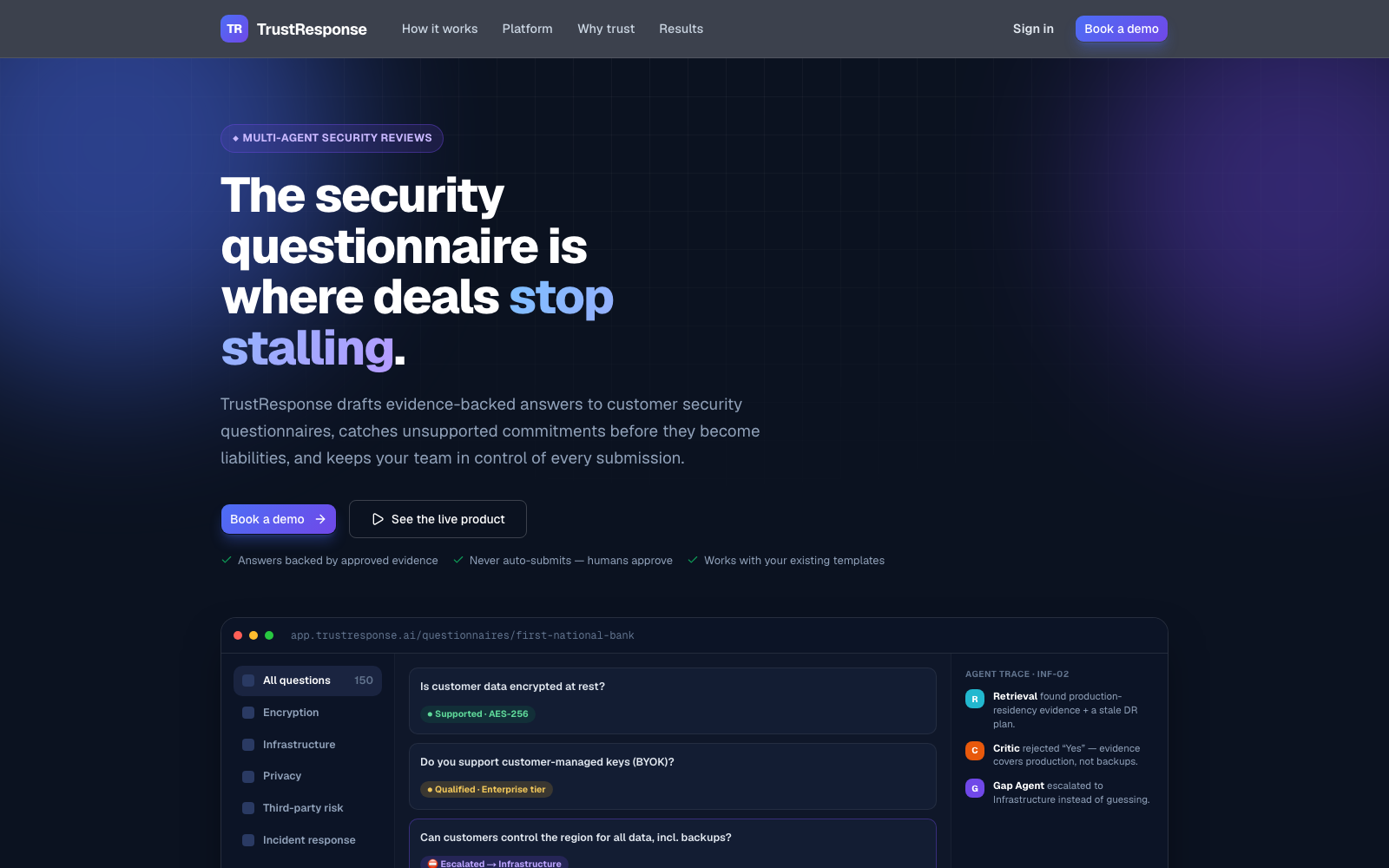
TrustResponse — Governed Multi-Agent Security Review
A governed multi-agent system that drafts evidence-backed answers to security questionnaires, catches unsupported commitments before they become liabilities, and routes anything risky to a human.
Problem
Security questionnaires stall enterprise deals for days, and an AI that auto-answers them will confidently commit a company to things it cannot back up.
Keep reading
When RAG Is the Wrong Solution
Retrieval-augmented generation has become the default answer to every enterprise AI question. It shouldn't be. Here's how to tell when it's the wrong tool.